HomeStyle & Beyond
Home ImprovementLivingDecorOutdoorTips & Guides
HomeStyle & Beyond

Elevating Everyday Living Through Inspired Design & Insight

HomeStyle & Beyond is your trusted guide to creating a home that reflects your unique style and enhances your everyday life. We provide expert advice, inspiring ideas, and practical solutions for every aspect of home and living.

Sections

  • Home Improvement
  • Living
  • Services
  • Decor
  • Organization
  • Outdoor
  • Maintenance

Writers

Meet our writers →

Trending Topics

Home DecorInterior DesignHome ImprovementHome MaintenanceHome RenovationDeclutteringHome OrganizationHvac

About

  • Contact
  • Privacy Policy
  • Terms of Service

© 2026 HomeStyle & Beyond. All rights reserved.

  1. Home
  2. /Outdoor
  3. /How to Amend Soil Types for Garden Health
Outdoor

How to Amend Soil Types for Garden Health

In a recent study, a specific soil amendment treatment (F2) dramatically boosted available phosphorus by an astonishing 834.

MC
Mason Clarke

April 23, 2026 · 6 min read

Close-up of hands amending rich garden soil with compost, surrounded by thriving plants and a hint of lush greenery.

In a recent study, a specific soil amendment treatment (F2) dramatically boosted available phosphorus by an astonishing 834.59%, alongside significant increases in available nitrogen by 133.33% and available potassium by 74.34%, according to PMC. A profound improvement transforms soil nutrient availability, setting a new standard for effective garden health in 2026.

Many gardeners often guess at their soil's specific needs, applying general amendments without precise data. However, this approach misses out on the exponential gains possible through data-driven strategies, which can deliver improvements far beyond conventional expectations.

Investing in scientific soil testing and understanding the specific impacts of tailored amendments will become a foundational practice for successful gardening, moving decisively beyond generic 'add compost' advice to unlock truly transformative plant health.

Understanding Your Soil's Foundation

Changes to soil health occur primarily in the top six inches. A six-inch sampling depth is thus commonly recommended for general assessment, according to the WSU Master Gardener Program. However, this universal recommendation often lacks precision for all planting scenarios. The UC Marin Master Gardeners, for example, advise varying depths: 2-4 inches for lawns, 6 to 8 inches for vegetable and perennial beds. The divergence in recommended sampling depths means even 'targeted' testing demands depth-awareness for accurate, plant-specific data.

Beyond sampling depth, understanding fundamental soil properties is essential. Soil pH, for example, can be significantly altered by amendments; treatments with soil amendments significantly increased soil pH compared to control conditions, according to PMC. Grasping these core soil characteristics and their measurement is crucial for any effective amendment strategy. Even beneficial amendments can alter fundamentals like pH, demanding careful monitoring.

Diagnosing Your Garden's Needs

Accurately assessing a garden's soil begins with precise sampling tailored to the specific plants being grown. Soil samples for trees and shrubs should be taken 6 inches deep, while those for vegetable and perennial beds require a depth of 6 to 8 inches, and lawns only need samples from 2-4 inches deep, advises the UC Marin Master Gardeners. The nuanced approach to sampling ensures that diagnostic results accurately reflect the conditions relevant to the plant's root zone, providing a clearer picture for targeted interventions.
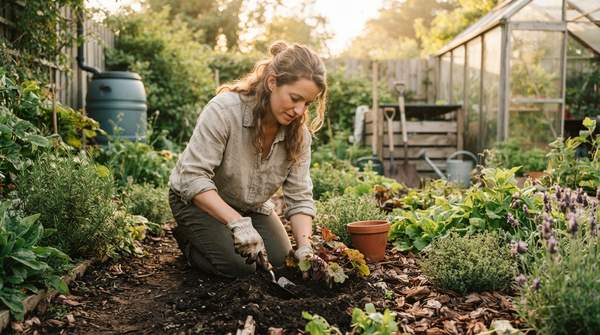
Evaluating soil drainage is another critical diagnostic step. Gardeners can check soil drainage by digging a 1-foot deep hole, filling it with water, letting it drain, refilling it, and then measuring the water drop over 15 minutes, multiplying by four to calculate the hourly drainage rate, according to the UC Marin Master Gardeners. The practical test reveals whether drainage is poor (less than one inch per hour), ideal (one to six inches per hour), or excessive (faster than six inches per hour), providing direct insight into a soil's physical structure.

Soil electrical conductivity (EC) offers further insights into soil health, especially concerning salinity and drainage. If soil EC is greater than 0.5, improving drainage, building raised beds, or planting salt-tolerant plants becomes necessary, states NDSU Extension. Soil electrical conductivity reveals the intrinsic link between chemical and physical soil properties; high EC often demands drainage improvement. Effective soil management must address both aspects holistically for optimal plant environments.

The Cost of Generic Approaches

Gardeners relying on generic soil amendments are actively underperforming, missing out on exponential nutrient availability that could revolutionize their garden's productivity. The dramatic 834.59% increase in available phosphorus from the F2 treatment alone proves untargeted, 'all-purpose' solutions cannot replicate the profound improvements demonstrated by specific, data-driven interventions. Reliance on guesswork leads to suboptimal plant growth and wasted effort, as resources are applied without precision or a clear understanding of actual soil deficiencies. The true cost extends beyond mere inefficiency; it's the forfeiture of a garden's full potential, a silent tax on yield and vitality.

Companies marketing 'all-purpose' soil solutions, while offering convenience, inadvertently perpetuate this suboptimal gardening. Evidence strongly indicates that highly specific, data-driven amendments are the only path to truly transformative soil improvement. Broad solutions provide some benefit, but they fall far short of unlocking a garden's full ecosystem potential. The nuanced requirements for sampling depth and the interplay between soil EC and drainage, discussed earlier, underscore that effective soil management is a precise science, not a casual endeavor. It demands targeted testing and specific interventions to unlock optimal plant health and yield, making generalized products a significant compromise.

The consequence of foregoing precise soil testing and tailored amendments is not merely slower growth; it is an active sacrifice of exponential gains in nutrient availability and plant health. Without a clear diagnostic picture, gardeners risk applying amendments that are either unnecessary, insufficient, or even detrimental to their specific soil type. This leads to wasted investment in products, lost time, and ultimately, reduced harvests. The hidden cost is the missed opportunity for a truly thriving garden, a potential left untapped due to a lack of scientific precision.

Targeted Amendments for Optimal Growth

The F2 treatment demonstrated the most significant improvement in available nitrogen, available phosphorus, and available potassium, with increases of 133.33%, 834.59%, and 74.34%, respectively, according to PMC. The astonishing 834.59% increase in available phosphorus proves specific, data-driven soil amendments can yield improvements almost an order of magnitude greater than baseline, far exceeding conventional expectations for soil enhancement. Such targeted interventions move beyond basic NPK, offering a multi-faceted approach to soil improvement.

Beyond nutrient availability, specific amendments can significantly improve soil structure. Applying biochar and vermicompost treatments effectively reduced soil bulk density and increased total soil porosity compared to control conditions, reports PMC. Physical improvements are critical for root penetration, water infiltration, and gas exchange, proving how targeted amendments enhance the very foundation of plant growth. Optimizing soil health extends beyond basic NPK, with these amendments effectively addressing the physical properties of soil.

Further proving the power of precise amendments, adding 0.2% mineral-source potassium fulvic acid optimizes cambisols’ properties, enhances aggregate formation and stability, and boosts tomato yield, showing great application potential, notes PMC. Specific compounds, even in small concentrations, can dramatically improve soil structure and directly impact crop productivity. Examples confirm targeted interventions fundamentally enhance the soil environment for superior plant performance, extending beyond mere nutrient addition.

What are the best soil amendments for vegetable gardens?

For vegetable gardens, specific organic amendments can boost key components. For instance, the B3 treatment in one study led to the highest increase in dissolved organic carbon (DOC), while the B5 treatment yielded the highest organic matter content, according to PMC. Targeted organic inputs contribute to a thriving microbial community and improved nutrient cycling essential for productive vegetable growth.

How do I improve clay soil for gardening?

Improving clay soil for gardening involves breaking up its dense structure to enhance aeration and water infiltration. Incorporating substantial amounts of organic matter, such as well-rotted compost or aged manure, can help create larger soil aggregates, reducing bulk density and improving drainage over time. Repeated applications over several seasons will gradually transform the soil's workability and fertility.

What is the difference between soil types?

Soil types primarily differ in their texture, which is determined by the proportion of sand, silt, and clay particles. Sandy soils have large particles, leading to excellent drainage but poor nutrient retention, while clay soils have tiny particles, resulting in high nutrient holding capacity but often poor drainage and aeration. Loam, considered ideal for gardening, offers a balanced mix of these particle sizes, providing good drainage, aeration, and nutrient retention.

By the end of 2026, gardeners adopting precise soil testing and targeted amendment strategies, like those demonstrating an 834.59% increase in available phosphorus, will likely see their yields and plant vitality surpass those relying on general methods by a significant margin, establishing a new benchmark for gardening success.

Related Coverage

  • Consumer Confidence Fuels Home Renovation Market Growth
  • What are Home Insulation R-Values and Installation Methods?
  • Wake County Drought Challenges Landscaping Curb Appeal
  • Choosing Smart Storage for Home Organization

Tags

Soil AmendmentGarden HealthSoil TestingGardening TipsNutrient AvailabilityOrganic GardeningSoil Science
MC

Mason Clarke

Outdoor & Real Estate Writer

Mason Clarke is the Outdoor & Real Estate Writer for HomeStyle & Beyond, covering real estate trends, gardening, and outdoor design. He approaches his work with a focus on helping readers navigate home buying and create sustainable, functional spaces.

More from Outdoor

A beautiful front yard filled with blooming native wildflowers and lush native grasses, demonstrating low-maintenance curb appeal and ecological benefits.

Top 6 Low-Maintenance Native Plants for Curb Appeal & Local Ecosystems

Once established, native grass lawns typically only need to be mowed once or twice a year, according to ABC News & Headlines .

Mason Clarke· Jul 21
A serene and inviting backyard oasis, featuring lush greenery, comfortable seating, and DIY landscaping elements, perfect for relaxation and entertaining.

10 Budget-Friendly DIY Landscaping Ideas for Your Backyard Oasis

You can save $70 to $140 on mulch delivery alone by picking it up yourself.

Mason Clarke· Jul 20
A lush, biodiverse backyard garden filled with native plants, attracting butterflies and birds, symbolizing a resilient and sustainable home.

What are sustainable landscaping principles for resilient homes?

It takes over 6,000 caterpillars to raise one brood of chickadees, a critical food source that traditional suburban lawns, often treated with 10 times more pesticides per acre than farmland, simply ca

Mason Clarke· Jul 19
A home exterior and garden covered in a light dusting of snow, with warm light from the windows, symbolizing winter preparation.

How to Prepare Your Home Exterior and Garden for Winter

Creosote buildup in a chimney can start a devastating house fire, posing a severe risk to property and lives.

Mason Clarke· Jul 19

Trending Now

1
A pristine small bathroom featuring innovative storage solutions, including an elegant over-the-toilet cabinet, floating wooden shelves, and a compact vanity, all contributing to a clutter-free and serene environment.

The 7 Best Storage Solutions for Small Bathrooms in 2026

Organization· 73 views
2
A stylish living room featuring an array of unique home accessories, including artisanal pottery, vintage books, and decorative objects, creating a personalized and inviting atmosphere.

The 7 Best Shops and Retailers for Unique Home Accessories in 2026

Decor· 30 views
3
A woman smiling, holding a neatly folded shirt in a sunlit, organized living room, embodying the peaceful results of the KonMari decluttering method.

How to Use the Marie Kondo KonMari Method: A Complete Guide

Organization· 17 views
4
Are You Making These 5 Boiler Repair Mistakes? Anchor Plumbing and Boiler Services Doesn't

Are You Making These 5 Boiler Repair Mistakes? Anchor Plumbing and Boiler Services Doesn't

Maintenance· 7 views
5
A cozy living room at dusk, illuminated by a unique mid-century modern vintage floor lamp, with other retro lighting fixtures subtly enhancing the warm, inviting ambiance.

The Best Online Retailers for Unique Vintage Lamps and Lighting

Decor· 13 views
6
A person smiling while organizing a beautifully decluttered closet, showcasing a seasonal swap strategy with neatly stored clothes and accessories for different times of the year.

How to Implement a Seasonal Swap Strategy — A Complete Guide

Organization· 6 views