You don't need to fold every piece of clothing; a drawer of jumbled underwear is organized enough to save you time and mental energy, according to The Guardian. A simple shift alleviates significant household stress. Many invest heavily in meticulous home organization, but this effort often creates stress instead of relieving it. The constant pursuit of perfect order leaves you overwhelmed and perpetually behind. While Martha Stewart suggests smarter storage saves time and stress, The Guardian offers a different path: lowering tidiness standards. Lowering tidiness standards reveals a core tension: is the answer more organization, or less? Embracing a minimalist, pragmatic approach to household storage appears more effective for reducing stress than traditional, time-intensive decluttering.
The Case for 'Good Enough' Organization
Too many items create a constant battle for space. "The more you own, the more your things own you," according to Modern Minimalism. Your home should be for living, not just storing unused items. "Treat your home as a space to live, not a storage unit." Holding onto things from a past self or for a future aspiration prevents you from living effectively now. Decluttering makes room for how you want to live today, fostering self-acceptance and reclaiming your space.
Stop over-folding. Meticulous folding of every garment wastes energy. A drawer of jumbled underwear is often organized enough, states The Guardian. Extend this to socks: reducing your collection to just two styles, with multiple pairs of each, eliminates sorting, matching, or rolling, drastically cutting laundry time and decision-making.
Give your "mess" a home. Designate specific "messy" zones, like a clothes chair or basket. "Give yourself permission to be messy – just give that mess a home," suggests The Guardian. This reduces guilt and contains temporary clutter without requiring immediate action.
Apply the 20/20 Rule for 'just in case' items. If an item can be replaced in under 20 minutes for under $20, it's usually safe to let it go. Modern Minimalism identifies this rule for 'just in case' clutter. The 20/20 Rule provides a clear guideline, freeing up space from items you rarely use.
Declutter incrementally. Consistently letting go of a small number of items, like 1-2 out of every 10, prevents major decluttering projects. Modern Minimalism suggests if you didn't wear a clothing item in 90 days or six months, it's likely something you can let go. Consistently letting go of a small number of items maintains order with minimal effort over time.
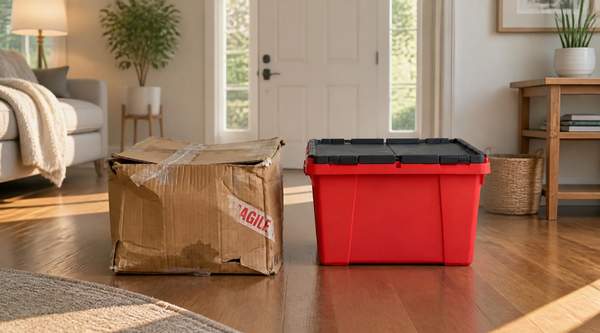
Smart storage supports, but doesn't replace, decluttering. While not a substitute for letting go, well-chosen storage solutions can enhance functionality for necessary items, saving time, space, and stress. But remember, the goal is less stuff, not just better ways to store it.
Traditional vs. Pragmatic Decluttering Approaches
The table below illustrates the core difference between traditional, perfection-driven organization and a pragmatic, 'good enough' approach. One drains you, the other empowers you.
| Approach | Goal | Time Investment | Mental Energy | Outcome |
|---|---|---|---|---|
| Traditional | Aesthetic perfection | High, ongoing | High, draining | Visually perfect but stressful |
| Pragmatic | Functional simplicity | Low, intermittent | Low, conserving | Functional, stress-reduced |
Principles for Stress-Free Storage Solutions
True efficiency in home organization stems from eliminating decision-making and repetitive, low-value tasks. Prioritize functional simplicity over aesthetic perfection. Reduce friction in your daily routines.
The most effective "smarter storage solution" isn't a new product; it's redefining "organized." Stop striving for showroom-ready spaces. Focus on systems that support your actual daily life with minimal effort, optimizing for ease of use. Optimizing for ease of use conserves your mental and physical energy, freeing bandwidth from rigid, impractical ideals. Your goal is daily tranquility, not magazine-spread tidiness.
Beyond the Closet: Reclaiming Your Mental Energy
A less-is-more approach to storage impacts more than just your home; it boosts overall life efficiency and mental well-being. Simplifying your physical environment creates mental space for meaningful pursuits.
Meticulous, unnecessary organizational tasks at home are "shallow organization." They consume mental bandwidth without proportional benefits. The Guardian highlights how shallow work, like excessive messaging, wastes energy better spent on bigger tasks. The same holds true for home organization: pragmatic approaches save vital mental resources, not just time.
Your Decluttering Questions Answered
How to declutter a small home effectively?
For a small home, focus on vertical storage and multi-functional furniture. Every item needs a designated home; anything without one should be considered for donation. Prioritize daily-use items and discard duplicates.
What are the best storage solutions for apartments?
Apartments benefit from solutions maximizing unused space: under-bed storage, over-the-door organizers, and slim rolling carts. Floating shelves and wall-mounted units save floor space. Consider items that fold flat when not in use. For more, see our Creative Storage Solutions for Maximizing.
How to organize a cluttered garage?
Organize a cluttered garage by categorizing items into zones like tools or seasonal decor. Utilize wall space with pegboards, shelving, and overhead racks to get items off the floor. Clearly labeled bins prevent future clutter.
Embracing 'good enough' organization, if widely adopted, appears likely to transform household management from a source of stress into a foundation for daily tranquility.


