The best boot storage for muddy weather depends on three things: where the boots will live (inside or outside), what kind of space you can spare (floor or wall), and how many pairs you need to handle. That is the honest answer, and it is why no single product solves everyone's mudroom mess. Below is a decision framework that walks you through those three questions, followed by a category-by-category comparison of the four main types of boot storage: rubber trays, freestanding floor racks, wall-mounted racks, and storage benches. The goal throughout is the same one home-organization writers at Closets For Less describe: keep boots upright, off the floor, and close to the door you actually use.
Choose Your Ideal Boot Storage: A Decision Framework
Before you shop, The Hat Rack Guy's editorial team recommends two simple prep steps: count your active pairs—not your whole collection—and measure the wall and floor space available. Both numbers drive everything that follows, because a solution sized for two daily pairs fails badly at six, and a floor-hungry rack is wasted money in a hallway with no footprint to spare.
Work through the three questions in order, and each answer narrows you toward one category:
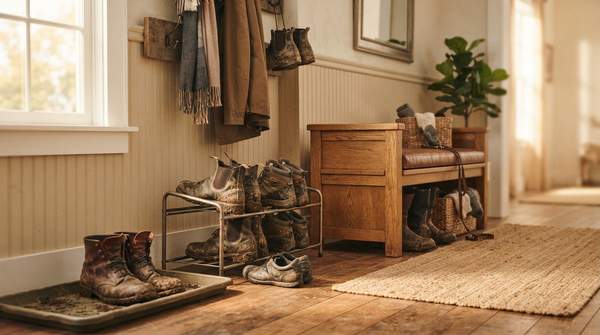
- Where will the boots live? If you have a porch, covered stoop, or garage apron, you can keep mud outside the threshold entirely. Sundayflat contributor Sophie Martinez reports exactly this from her own setup: a slim porch boot rack paired with a drip tray meant "the dirt never crosses the threshold." No porch? You are choosing an indoor solution with containment built in.
- What kind of space do you have? Tight floor near the door pushes you toward a tray or wall-mounted rack. The Hat Rack Guy's guidance for small mudrooms is blunt: use vertical space instead of the floor. Generous floor space opens up freestanding racks and benches.
- What is your priority: containing mess or maximizing organization? If muddy puddles by the door are your enemy, containment features (drip trays, wipeable surfaces) come first. If boots are constantly scattered and lost, open, visible organization wins.
The matrix below shows how the four categories trade off against each other on the criteria that matter most in muddy season.
| Type | Space Efficiency | Mud/Water Containment | Ease of Access | Durability Notes |
|---|---|---|---|---|
| Rubber tray | Minimal footprint; slides anywhere | Strong—catches drips and puddles directly | Excellent; boots drop straight in | Simple wipeable surface; low failure points |
| Freestanding floor rack | Organizes pairs vertically instead of in a pile | Weak on its own; Martinez adds a catch tray under hers | Excellent; open storage, no digging | Varies by model; capacity depends on design |
| Wall-mounted rack | Best in class—clears the floor entirely | Weak; needs a tray beneath to catch drips | Very good; boots visible at a glance | Heavy-duty aluminum models carry a manufacturer's lifetime guarantee against rust and corrosion |
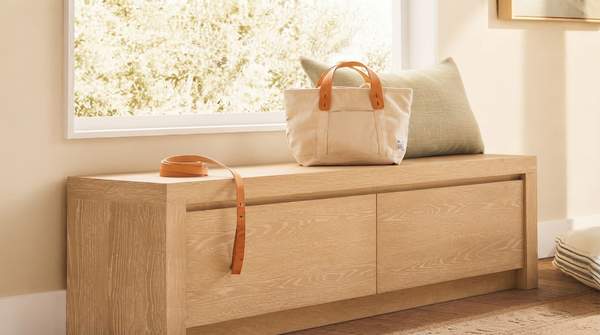
| Storage bench | Larger footprint, but doubles as seating | Hidden compartments help; drips still land on the floor | Good; sit-and-remove access | Bulk is the trade-off, not fragility |
If your framework answers landed on "tray," you are in luck: it is the cheapest and simplest category. A boot tray under daily pairs catches water and grit where it falls, and pairing one with a rack—an option Martinez credits with solving her own "muddy puddle by the door" problem—combines containment with organization. The remaining three categories get a closer look below.