Blending vintage and modern decor succeeds or fails on one factor: intentionality. Designers who write about mixing periods converge on the same core method—start with a neutral modern foundation, connect pieces through a shared color or material thread, and use contrast and focal points deliberately rather than accumulating pieces at random. A widely cited working guideline is a ratio of roughly 60% neutral modern pieces to 40% vintage accents, which keeps a room feeling contemporary while letting older pieces read as intentional choices rather than clutter. Here is how to apply that method, step by step, in any room of your home.
Step-by-Step Decision Framework for Cohesive Decor
Before you evaluate any single item, decide the overall feel you want—elegant, relaxed, classic, or unorthodox, as the interior design writers at Hommés Studio put it—and gather reference images on a board so you can identify what you actually love before spending anything. This first step matters more than it sounds: without a defined feel, every vintage find looks appealing, and that is exactly how mismatched rooms happen. The mood board becomes your filter, letting you reject pieces that are attractive in isolation but wrong for the direction you have chosen.
Next, settle on a color palette. If you own many interesting individual pieces, a neutral palette is the safer choice, because dramatic wall color is rarely needed when the furniture itself carries the visual interest. The palette does not have to be beige—soft neutrals, or a few complementary colors used consistently, both work. What matters is that color becomes the quiet constant that lets very different eras of furniture sit in the same room without arguing. Once the feel and palette are fixed, every purchase or placement decision can run through the same sequence of questions: Does the piece sit on your neutral base without overwhelming it?
Does it share a common thread—color, material, or shape—with what you already own? Could it serve as a focal point, or is it a supporting accent? Does its visual weight balance what sits near it? Do its finishes add depth rather than noise?
Your Decision Framework for Blending Vintage and Modern Decor
Use this matrix to evaluate each existing or candidate piece, in order. A piece that fails a step is not necessarily wrong—it may simply need a different placement, a different partner piece, or removal from the room entirely. The framework works because each step builds on the last: the base creates calm, the common thread creates unity, the focal point creates character, and contrast and finish create interest.
| Step | Decision question | What the evidence says works | Worked example |
|---|---|---|---|
| 1. Establish a neutral base | Does the room have a calm, largely modern foundation? | Keep roughly 60% of the room neutral and modern, 40% vintage accents; avoid filling the room with all one era. | Clean-lined sofa and simple wall color as the backdrop. |
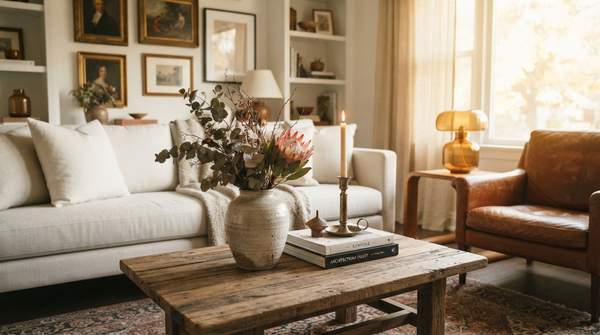
| 2. Find a common thread | Does the piece share a color, material, or shape with the room? | Choose a few complementary colors; bridge styles with shared materials such as wood with sleek metals, or warm metallics like copper and brass. | A rustic barn-wood shelf against white walls with contemporary decor. |
| 3. Choose a focal point | Could one vintage piece anchor the room as a statement? | Let a single ornate or aged piece draw the eye in an otherwise simple space. | A glass-and-steel shelving unit placed intentionally beside a Victorian-era writing desk. |
| 4. Balance with contrast and visual weight | Does the piece's weight balance its neighbors? | Place modern and antique side by side to highlight both; pair heavy with light so the eye moves around the room instead of getting stuck. | A heavy, dark antique cabinet balanced by a sleek, light-toned modern chair; a bulky sectional softened by a delicate vintage coffee table. |
| 5. Coordinate finishes and materials | Do the textures add depth without clashing? | Mix curvy vintage forms with angular modern ones; combine glossy and matte, metal and wood, glass and stone. | A round Art Deco mirror against linear modern shelving. |
The proportion principle is the framework's backbone. As one decor guide summarizes the approach, mixing periods works best when you think about visual weight: a heavy ornate cabinet needs a light, modern sofa nearby to balance it. Notice that this cuts against the instinct to group like with like. Distributing weight across the room, rather than clumping every substantial piece on one side, is what lets the eye move comfortably instead of getting stuck.
Contrast is not a risk to minimize but the point of the exercise. Pairing a modern sofa with an antique lamp highlights both styles, according to Kelsey O'Brien, writing for MK Envision Galleries. The same logic applies to accessories: antique vases or vintage-inspired art prints added to a modern setting contribute character without overwhelming the space, precisely because the modern base holds them in context. And when two styles seem far apart—rustic and modern, for instance—they can still blend beautifully when grounded in a cohesive color scheme and material palette, with warm metallic finishes like copper and brass, or soft neutrals, bridging the gap.