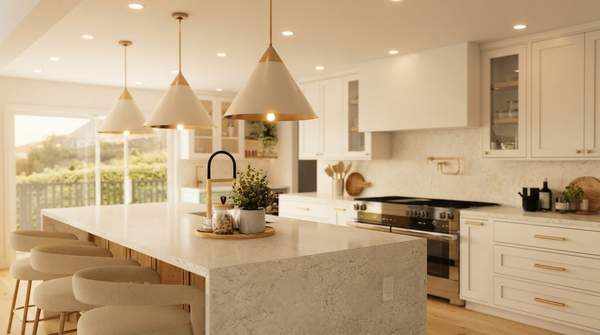
Selecting the ideal lighting for your home involves more than just illumination; it's about shaping atmosphere, enhancing design, and meeting practical needs. For homeowners looking to optimize their home's lighting, recessed and pendant fixtures stand out as versatile choices. Understanding their distinct characteristics, functional benefits, and aesthetic impacts is key to confidently choosing between them, or even combining them, for various rooms in your home.
Understanding Recessed Lighting: The Seamless Solution
Recessed lighting, often referred to as can lights or downlights, offers a sleek and minimalist aesthetic by fitting flush with your ceiling. This design creates an unobtrusive look, blending seamlessly into the architectural lines of a room, as noted by ANC Lighting, a custom lighting manufacturer. This type of fixture is a favorite for contemporary or minimalist interiors, providing clean lines and an uncluttered feel, according to Jolux Lighting.
Primarily, recessed lighting excels at delivering even, widespread ambient or general illumination across larger spaces. While its main role is to provide consistent light, it can also be adapted for task or accent lighting when equipped with specific beam spreads. Aiwen Lighting highlights that recessed lights are perfect for high-traffic areas or rooms requiring uniform light throughout, such as living rooms, hallways, bathrooms, and basements. Their ability to provide consistent lighting makes them a practical choice for modernizing older homes, Jolux Lighting adds.Exploring Pendant Lighting: The Decorative Focal Point
In contrast to the subtle nature of recessed lights, pendant lighting features fixtures that hang from the ceiling, typically suspended by a cord, chain, or rod. These "hanging gems," as described by Aiwen Lighting, are often chosen for their decorative appeal and ability to create a statement in a room. ANC Lighting emphasizes that pendant lights serve as a focal point, adding visual interest and a sense of style, drawing the eye upwards and contributing a layer of visual interest to the space.
Pendant lights come in a variety of shapes, sizes, and finishes, making them versatile enough to complement a wide range of interior styles. While they contribute to ambient light and serve as an accent, their primary strength lies in providing focused task lighting over specific areas. For instance, Aiwen Lighting suggests they are ideal for illuminating kitchen islands or dining tables. Jolux Lighting also points out that pendant lights can increase perceived home value due to their strong visual impact, often seen as more "designer" in real estate listings.