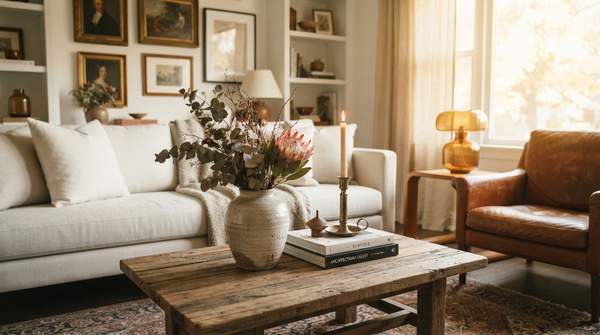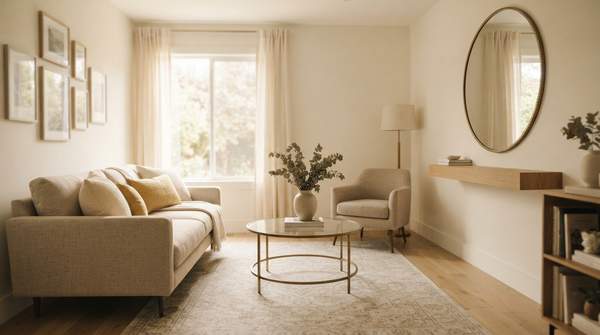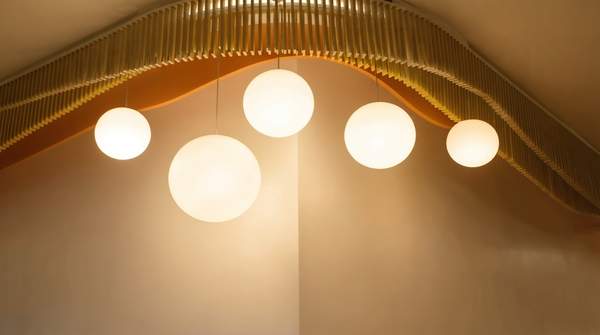
The best statement fixture for your living room is the one that matches three things at once: your ceiling height, your room's scale, and the job you want the light to do. A chandelier works beautifully in a room with the height to carry it, while a large pendant delivers similar drama where space is tighter, and a sculptural floor lamp or unconventional wall sconce can anchor the room without touching the ceiling at all. Here is how to weigh those options and pick with confidence.
Understanding Statement Lighting in Your Living Room
Statement lighting is a fixture chosen as much for its presence as for its light. As designer Claire Crowe puts it, statement pieces—whether oversized chandeliers, geometric pendants, or sculptural floor lamps—"can add warmth, drama, or even a sense of excitement to a space that might otherwise feel bland." A grand chandelier can make a room feel elegant and luxurious, while a bold floor lamp in a minimalist living room can introduce a layer of intrigue without any renovation.
One point worth internalizing early: size alone doesn't make a statement. Lighting Reimagined notes that a petite decorative lamp with unique design elements can command just as much attention as an oversized chandelier—what matters is how well the piece anchors the space and contributes to the room's overall character. That frees you to shop by design impact rather than raw dimensions, and it opens the field well beyond the biggest fixture you can find.
It's also worth questioning the assumption that only chandeliers qualify. Laura U Design Collective, writing through contributor Elizabeth Burton, pushes back directly on the idea that table lamps, floor lamps, and wall sconces are merely secondary: "This could not be further from the truth." In their view, mammoth floor lamps and unconventional wall sconces can pack just as much punch as classic crystal chandeliers or modern pendants—so your shortlist should be built on impact, not fixture category.
What ties all of these together is the idea of anchoring. A statement piece earns its name by drawing the eye and setting the tone for everything around it, which is why the same fixture can feel stunning in one room and lost in another. That's why the practical checks later in this guide—ceiling height, room size, and harmony with existing decor—matter as much as the fixture's design itself.
The Three Layers of Living Room Lighting
Before choosing a fixture, know what job it will do. Interior lighting generally works in three functional layers, and a statement piece can serve one or more of them at once. Thinking in layers keeps you from expecting one beautiful fixture to do everything—and from being disappointed when it can't.
- General lighting provides overall visibility for the whole room. A chandelier is the classic example—Visual Comfort describes chandeliers as providing "general light for visibility" while serving as the crown jewel of a space.
- Task lighting supports specific activities like reading or working, typically from a directed source positioned close to where you need it.
- Mood lighting creates atmosphere and ambiance. Pendant lights, Visual Comfort notes, "make a dramatic impression that will help create the ambiance you're looking for," while wall sconces can contribute both ambient and accent light.
Notice that these layers don't map neatly onto fixture types. A chandelier is primarily a general-lighting piece, but a pendant can lean toward mood, and sconces split their duties between ambient and accent. That overlap is useful: it means a statement fixture can lead your lighting plan while other sources fill in around it.
The practical takeaway: even the most striking chandelier shouldn't be your only light source. Because it primarily delivers general illumination, it works best layered with other fixtures that handle task and mood duties. A statement piece can anchor the lighting plan, but it rarely completes one on its own—and the designers cited here consistently treat layering as the foundation of a well-lit room.
Statement Lighting Decision Framework
The matrix below maps the four most common statement fixture types against their style impact, the room conditions they suit best, and the lighting function they perform. Use it to narrow your shortlist to one or two candidates before you shop.
| Fixture Type | Primary Style Impact | Best For (Room Condition) | Lighting Function |
|---|---|---|---|
| Chandeliers | The room's crown jewel; creates an immediate impression, ranging from ornate and traditional to sleek and modern | Rooms with normal ceiling height call for a short chandelier so it won't interfere with walking around | Primarily general light for visibility; a focal point best layered with other sources |
| Large Pendants | Significant impact driven by unique design elements rather than sheer size | Spaces where you want a large fixture but space is a constraint | Creates ambiance and a dramatic impression |
| Sculptural Floor Lamps | Adds warmth, drama, or excitement; can be mammoth in scale | Rooms where you want to anchor a zone—like a minimalist living room—without ceiling work | Contributes to the layered plan alongside other sources |
| Wall Sconces | Unconventional designs add character and can be genuinely impactful | Works with, not instead of, other lighting | Provides both ambient and accent lighting |
Reading the matrix as a decision: if your ceiling is standard height and you want one fixture to carry the room, a short-profile chandelier is the natural fit. If the room feels tight for a full chandelier, a large pendant delivers comparable drama in a smaller footprint—Visual Comfort describes pendants as fixtures that "don't take up as much space, but still make a big impact."
If you'd rather not commit to a ceiling fixture at all—or you want to spotlight a seating area—a sculptural floor lamp anchors the space on its own terms, bringing warmth or intrigue exactly where you place it. Wall sconces, meanwhile, are best treated as supporting players: they add character and ambient glow within a layered plan rather than carrying the room alone.
You can also combine rows. A short chandelier for general light, flanked by unconventional sconces for accent, covers two layers while giving the room two points of visual interest. The framework isn't about picking a single winner—it's about matching each fixture's strengths to what your room actually needs.
Practical Considerations for Selecting Your Fixture
Once you've narrowed the type, run through this checklist before buying. Each item traces back to a real constraint that determines whether a statement piece succeeds or falls flat in your space.
- Assess room size and shape. A fixture that overwhelms a small room—or disappears in a large one—loses its statement power. Remember that impact comes from design and how well the piece anchors the space, not just scale.
- Measure ceiling height. Visual Comfort advises considering both the size and ceiling height of your room when placing statement lighting. With normal ceilings, choose a short chandelier so it doesn't interfere with movement through the room.
- Consider your color scheme and existing decor. A statement piece works by anchoring the room's character, so it should harmonize with what's already there—whether that's ornate and traditional or sleek and modern.
- Plan the layers. Decide which of the three lighting functions your statement piece will cover, and make sure other fixtures fill the gaps rather than leaving one fixture to do everything.
One boundary to keep in mind: this guide covers fixture selection only. Installation and wiring are separate matters that this article doesn't address, and it doesn't recommend specific brands or models. It also focuses on interior living room lighting, so exterior fixtures—impactful as they may be—fall outside this framework.
Making Your Final Statement Lighting Choice
Select a statement lighting fixture that harmonizes with your living room's dimensions, existing decor, and desired lighting functions. The check that you've chosen well is concrete: the chosen fixture's diameter and hanging height align with your room measurements, and its style complements the existing aesthetic while contributing to the intended ambiance. Measure your room, match it against the framework above, and you'll walk into the showroom knowing exactly which one or two fixture types deserve your attention.
Sources
- Statement Lighting Fixtures: Bold Ideas — Lighting Reimagined
- The Art of Statement Lighting in Modern Homes — Visual Comfort & Co.