You can meaningfully cut your family's exposure to the most common household toxins—lead, endocrine disruptors like phthalates and PFAS, and volatile organic compounds (VOCs)—without expensive renovations. Public health guidance from the EPA, NIH, and Harvard's School of Public Health points to a consistent pattern: know where each chemical hides, then act on a few targeted, low-cost steps, with dust control doing much of the heavy lifting. Here is a room-by-room framework for doing exactly that.
Understanding Common Household Toxins
Many everyday household products—cleaners, furniture, and flooring among them—can contain toxic chemicals, according to the Washington State Department of Ecology. These substances can build up in your home's air and dust, increasing exposure over time, and children and pets are especially vulnerable.
Young children face particular risk for two reasons, as NIH's News in Health explains: their bodies and brains are still developing, and normal childhood behaviors—playing on the floor, putting toys and hands in their mouths—bring them into closer contact with whatever settles there. As environmental health expert Dr. Ami Zota of George Washington University puts it, "Chemicals can come out of our products and end up in the air and dust in the home, where they can enter your body."
The three categories below account for the most common chemical exposures in typical homes. Each has distinct sources, health concerns, and fixes.
Lead: Sources, Risks, and Reduction
Lead is a heavy metal, and its main entry points in homes are old paint, dust, soil, and drinking water. The EPA notes that approximately three-quarters of homes in the United States built before 1978 still contain some lead-based paint. Lead in soil can also be tracked indoors on shoes, clothes, or other objects, contributing to lead in household dust.
In drinking water, how much lead you get depends on the water's chemistry, how much lead the water contacts, how long it sits in plumbing, and whether protective coatings line the pipes, according to the EPA.
The health stakes are highest for kids: young children are more vulnerable to lead and many other chemicals because their bodies and brains are still developing. If you live in an older home, NIH recommends checking with your local health department about lead that may be in the paint, dust, or drinking water—local experts can guide you on prevention steps. The EPA emphasizes that understanding the sources of lead in your home helps you determine which steps will be most effective, and that simple actions at home can reduce your family's risk.
Endocrine Disruptors (Phthalates & PFAS): Identifying and Avoiding
Endocrine disruptors interfere with natural hormones, and they may pose their greatest risks when exposure happens in the womb or during the first few years of life, when hormones guide development of organs and the brain. NIH-funded researchers study several chemical classes tied to hormone disruption, including phthalates, perfluorinated chemicals, and flame retardants. Substances thought to cause endocrine disruption include certain fragrances, pesticides, and stain-resistant coatings.
Phthalates are a family of man-made chemicals used to make plastics, cleaners, and fragrances. Harvard's School of Public Health reports that common items—cleaning supplies, vinyl flooring, shower curtains, carpet pads, and couches—contain endocrine disruptors linked with health problems including asthma, fertility issues, thyroid disease, and cancer. The human health effects of phthalates are not yet fully known, though in animals, exposure has been linked to reproductive and developmental problems.
PFAS are persistent chemicals used in a wide range of products, and the EPA reports that peer-reviewed studies show exposure to certain levels may lead to reproductive effects such as decreased fertility, developmental effects or delays in children, and increased risk of some cancers, including prostate, kidney, and testicular cancers. Young children face higher exposure risk because they crawl on floors and put things in their mouths, contacting PFAS in carpets, household dust, toys, and cleaning products.
To reduce exposure, NIH advises reading product labels and avoiding products that contain phthalates—though they may appear as 3- or 4-letter abbreviations such as BBP, DBP, or DEP, or hide inside the word "fragrance." Harvard environmental health researcher Robin Dodson recommends avoiding vinyl items (flooring, wallpaper, window shades, mattress protectors, shower curtains), skipping stain- or water-resistant products because they likely contain PFAS, and avoiding carpets or rugs with adhesive backing or recycled foam pads, which can contain flame retardants.
Volatile Organic Compounds (VOCs): Indoor Air Quality and Mitigation
VOCs are gases emitted by products such as paints, and they affect indoor air quality. One straightforward mitigation step comes from Harvard's guidance: choose wall paint that is low in VOCs and free of alkylphenol ethoxylates (APEs), another endocrine disruptor.
It's worth knowing the regulatory landscape, too. The EPA states that no federally enforceable standards have been set for VOCs in non-industrial settings. That means there is no legal ceiling you can rely on—reducing VOC exposure is largely a matter of product selection and ventilation choices you make yourself. The EPA points readers to guidelines and recommendations set by various organizations, including formaldehyde concentration recommendations, for those who want reference levels.
Household Dust: A Key Vector for Chemical Exposure
If you tackle only one thing, make it dust. The Washington State Department of Ecology is blunt: dust isn't just dirt—it can carry toxic chemicals. Because chemicals shed from products collect in dust, removing and preventing dust buildup is one of the best ways to reduce your exposure. Children are especially vulnerable to ingesting or inhaling contaminated dust, and PFAS reach kids through carpets, dust, toys, and cleaning products.
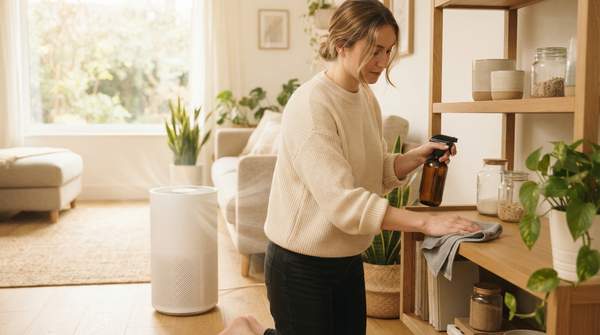
The good news is that effective dust control is cheap and simple. Based on guidance from the Department of Ecology and Harvard, your checklist looks like this:
- Wipe dusty surfaces with a microfiber cloth or a damp rag rather than a dry one, which just stirs particles back into the air.
- Remove shoes at the door, since chemicals and lead-contaminated soil can enter the home via the soles.
- Mop hard floors regularly to capture dust that a vacuum or broom can miss.
- Wash hands and children's toys frequently, given how much ends up in kids' mouths.
Each of these steps addresses multiple chemical categories at once—lead tracked in from soil, phthalates from vinyl, PFAS from carpets—making dust control the highest-leverage habit in this whole article.
Toxin Reduction Decision Framework
Use this table to diagnose your own home: find the materials and products you actually have, then take the matching action. The framework cross-references each toxin category with its common sources, health concerns, and evidence-backed mitigation steps drawn from EPA, NIH, and Harvard guidance.
| Toxin Category | Common Household Sources | Primary Health Concerns | Actionable Mitigation Steps |
|---|---|---|---|
| Lead | Old paint (about three-quarters of pre-1978 US homes contain some), household dust, soil tracked in on shoes, and drinking water in older plumbing | Harm to developing bodies and brains; young children are most vulnerable | Check with your local health department about lead in paint, dust, or water; remove shoes at the door; control dust; learn your home's specific lead sources to target the most effective steps |
| Endocrine disruptors: phthalates | Vinyl flooring, wallpaper, window shades, mattress protectors, shower curtains, cleaners, and fragrances | Linked in animals to reproductive and developmental problems; human effects still under study by NIH and other agencies | Read labels and avoid phthalates (watch for BBP, DBP, DEP, or "fragrance"); avoid vinyl products |
| Endocrine disruptors: PFAS | Stain- or water-resistant products, carpets, household dust, toys, cleaning products, and PFAS-packaged foods | Associated with reproductive effects, developmental delays in children, and increased risk of certain cancers | Skip stain- and water-resistant products; choose products without PFAS; control household dust, especially where children crawl and play |
| VOCs | Wall paint and other products emitting gases into indoor air | Reduced indoor air quality; no federally enforceable standards exist for non-industrial settings | Choose low-VOC, APE-free wall paint; consult existing organizational guidelines if you want reference concentrations |
Start with the row that matches your biggest concern: an older home points to lead, new furnishings or flooring point to endocrine disruptors, and any painting project points to VOCs. Note that this is general guidance, not medical advice, and it doesn't cover testing—for that, contact your local health department or a certified professional. Recommendations here follow product categories identified by public health agencies, not specific brands.
Empowering Your Healthier Home Journey
Homeowners should prioritize identifying and mitigating sources of lead, endocrine disruptors, and VOCs in their homes, focusing on consistent dust control and informed product choices. You don't need to do everything at once: pick one row of the framework, act on it this week, and add the next when a purchase or renovation makes it relevant.
The measurable indicator of progress is a noticeable reduction in household dust accumulation and a conscious shift towards products and practices aligned with public health guidance. Watch for those two changes over the coming months—less dust on surfaces between cleanings, and fewer vinyl, fragrance-heavy, and stain-resistant items coming through your door. That visible shift is your evidence that exposure is trending down.
Sources
- Making a Healthier Home — NIH News in Health
- Healthy home tips - Washington State Department of Ecology
- Reduce the Risk of Lead Exposure at Home — US EPA
- Minimizing exposure to chemicals in the home — Harvard T.H. Chan School of Public Health
- Our Current Understanding of the Human Health and Environmental Risks of PFAS — US EPA
- Volatile Organic Compounds' Impact on Indoor Air Quality — US EPA