Yes, you can clean your home effectively with a few simple pantry ingredients, but only if you respect their chemistry. White vinegar dissolves mineral deposits, castile soap lifts dirt as a base, and certain essential oils add antimicrobial power and scent. The catch: combining them wrongly can undo your cleaner or damage surfaces, and one mixture, bleach and vinegar, releases toxic chlorine gas. This guide explains how each ingredient works, where it fails, and how to choose the right one for the job.
Understanding Natural Cleaning: Beyond Basic Recipes
A recipe tells you what to mix. A working knowledge of each ingredient tells you why, and that knowledge is what prevents the two most common DIY cleaning mistakes: ruining a surface and canceling out your own cleaner.
The David Suzuki Foundation, a long-running source of DIY green cleaning recipes, flags the single most frequent error: mixing an acid with a base. In practical terms, that usually means adding vinegar to castile soap. The result, the Foundation explains, is an acid-base neutralization reaction that is "not dangerous" but takes the soap back to its original oils, leaving a white, curdled mixture that cleans poorly.
The same logic extends to commercial products: Green Llama's DIY guide warns that bleach and ammonia produce toxic chloramine gas, and bleach and vinegar produce chlorine gas, citing the American Lung Association on the danger. Knowing which ingredients sit on which side of the acid-base line is the foundation for everything that follows.
The Power of Common Ingredients: What They Do and How They Work
Each ingredient in your natural toolkit works through a distinct mechanism, and that mechanism explains both its strengths and its limits.
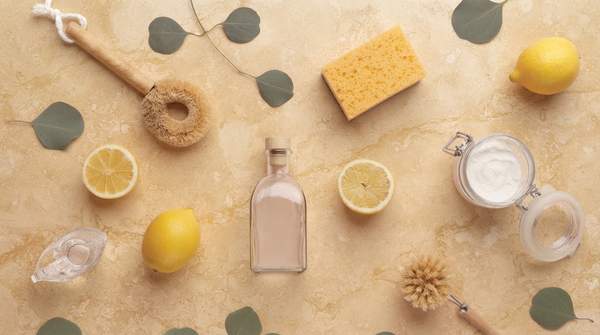
White vinegar is an acid. That acidity dissolves hard-water deposits and soap scum, which is why it excels on glass, fixtures, and tile. But the same acidity is a liability on natural stone such as marble, granite, or travertine, where Green Llama warns it can etch and dull the surface. For tough jobs, the David Suzuki Foundation suggests full-strength vinegar; for lighter cleaning, a 50:50 dilution with water.
Castile soap is a plant-based soap that works as a base. Green Llama recommends it as an all-purpose option for surfaces and floors, where its soap action lifts dirt without the acidity that harms stone. Its weakness is the mirror image of vinegar's strength: it cannot dissolve mineral buildup, and it cannot be combined with vinegar without neutralizing both.
Essential oils are supporting players rather than primary cleaners. Tea tree oil has been documented in scientific studies, as summarized by Homecourt, to inhibit the growth of a wide spectrum of pathogens when used in cleaning solutions, typically diluted with water or mixed with other natural ingredients like vinegar. Lemon oil is noted for cutting grease, eucalyptus oil contains the compound eucalyptol, and peppermint oil contains menthol; Homecourt also highlights peppermint oil's ability to repel ants, spiders, and rodents, giving it a dual cleaning and pest-deterrent role.
Natural Cleaning Ingredients: A Quick Reference Guide
Use this table as a decision guide: find your ingredient, read its mechanism, match it to the task, and check the warnings before you mix anything.
| Ingredient | Cleaning Action | Best For | Do Not Use On | Do Not Mix With |
|---|---|---|---|---|
| White vinegar | Acid; dissolves hard-water deposits and soap scum | Glass, fixtures, tile, tubs, and sinks; full strength for tough jobs, 50:50 diluted otherwise | Natural stone (marble, granite, travertine), which it can etch and dull | Castile soap (neutralizes both); bleach (toxic chlorine gas) |
| Castile soap | Base; soap action lifts dirt and grime | General surfaces and floors as an all-purpose cleaner | No surface restriction noted in our sources | Vinegar and other acids, which curdle the soap and undo its cleaning action |
| Essential oils (tea tree, lemon, eucalyptus, peppermint) | Antimicrobial and deodorizing additive; tea tree oil inhibits pathogen growth in studies; peppermint also deters pests | Diluted additions to cleaning solutions; deodorizing and freshening scent | Not specified in our sources | Not specified in our sources |
Two rows deserve emphasis. The vinegar-and-castile-soap combination is ineffective, not hazardous: the soap curdles and both cleaners lose power. The vinegar-and-bleach combination is the opposite, a genuine safety hazard that produces chlorine gas. Neither should ever appear in the same bottle.
Cleaning vs. Disinfecting: Setting Realistic Expectations
The most useful distinction in any cleaning routine is the one Green Llama draws plainly: "Cleaning removes. Disinfecting kills." Cleaning lifts dirt and grime off a surface; disinfecting uses a germ-killing agent to destroy pathogens.
Most DIY formulas, Green Llama cautions, are for cleaning, not hospital-grade disinfection. That makes them appropriate for everyday messes, counters, floors, sinks, and general freshening, where dirt removal is the actual goal. Green Llama also flags the opposite mistake: over-relying on medical-grade disinfectants for ordinary messes, which adds unnecessary chemical exposure to a home.
Where does that leave the antimicrobial evidence for essential oils? Tea tree, eucalyptus, and peppermint oils do have documented pathogen-inhibiting and disinfecting properties in the studies Homecourt summarizes, so they can meaningfully supplement a cleaning routine. But a DIY formula with essential oils is not a registered disinfectant with proven efficacy against specific pathogens. For a true disinfection job, such as after raw-meat spills or illness in the household, consult EPA guidance on registered disinfectants rather than expecting a pantry recipe to do that work.
Empowering Your Eco-Friendly Cleaning Choices
Homeowners can effectively and safely reduce their environmental footprint and chemical exposure by understanding the specific properties and limitations of natural cleaning ingredients. The practical rules are short: keep acids away from natural stone, never combine vinegar with castile soap in one bottle, and never mix vinegar or ammonia with bleach under any circumstances.
A few habits round out safe practice. Green Llama advises labeling every homemade mixture with its contents and the date it was made, and always spot-testing a new formula on an inconspicuous area first. Homecourt adds that even natural ingredients should be stored securely, away from children and pets, since safer does not mean harmless if mishandled.
The measurable outcome of following this guide is fewer damaged surfaces from improper cleaner use and greater confidence in selecting the right natural solution for each daily task. Watch for two concrete indicators as you adopt these ingredients: no etching or dulling on your stone counters, and no curdled, separated mixtures in your spray bottles. If both hold true, you are using your toolkit correctly, and for any job that requires killing specific pathogens, that is the moment to reach for EPA-registered disinfectants instead of a DIY formula.
Sources
- Environmentally friendly ingredients for DIY cleaning recipes — David Suzuki Foundation
- The Ultimate Guide to DIY Natural Cleaning Recipes — Green Llama
- Natural Cleaning Products - Safe & Effective — Homecourt
- Non-Toxic Cleaning Products: A Guide for a Healthy Home — Green Llama