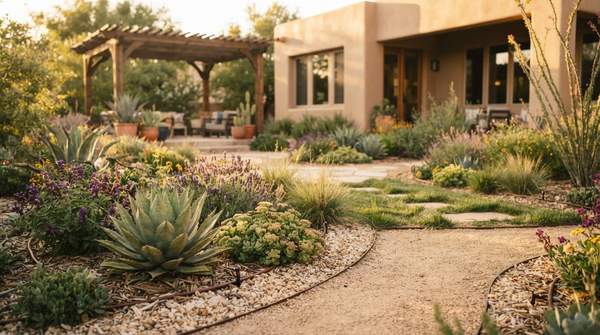
Xeriscaping is not a single technique but an integrated system built on seven principles: planning and design, soil improvement, efficient irrigation, appropriate plant selection, mulching, limited turf areas, and proper maintenance. University horticulture experts at New Mexico State University describe xeriscape as incorporating exactly these seven water-conserving principles, and Colorado State University Extension horticulturist John Murgel emphasizes that applying them together lets homeowners reduce both water consumption and maintenance while cultivating a garden that supports long-term ecosystem health. The payoff is real: drought-tolerant design reduces water bills and cuts water waste.
Introduction to Xeriscaping: Designing for Water Efficiency
The term describes landscaping designed specifically to thrive with minimal supplemental water, a meaningful advantage in drought-prone regions where outdoor irrigation drives household water use. New Mexico State University's landscape water conservation guide frames xeriscape around seven pillars that work as a system rather than a checklist: planning and design; efficient irrigation systems, properly designed and maintained; use of mulch; soil preparation; appropriate turf; water-efficient plant material; and appropriate maintenance.
Each principle reinforces the others. A thoughtful design reduces how much irrigation is needed; healthy soil holds the water that efficient systems deliver; mulch protects that moisture; and appropriate maintenance keeps the whole system performing. Skip a principle and the others have to compensate—usually with more water.
Principle 1: Thoughtful Planning and Design with Water-Use Zones
Murgel calls planning the make-or-break step: "Good planning makes for good gardens," and skipping it sets you up for frustration down the road. Planning starts with understanding your site—soil properties, sun exposure, how water flows across the property, and any microclimates you can take advantage of. As he puts it, the big idea is to match the right plants to the right place rather than forcing the landscape to match the plants you wish you could grow.
Practically, this means mapping your property first: structures, trees, shrubs, garden beds, property lines, the driveway, utility lines, and land contours, along with environmental conditions such as full sun, partial shade, deep shade, existing drainage patterns, low spots where water collects, and slopes prone to runoff.
With that map in hand, New Mexico State University recommends dividing the xeriscape into zones with different water requirements. The zone with the highest water use—the "oasis"—is usually where people spend the most time, making the patio area and perhaps the entry area the natural candidates. Grouping plants by similar water needs within these zones means no plant is overwatered to satisfy a thirstier neighbor.