Before you browse a single product page, make one decision first: which category of entryway storage you actually need. The five most common types—wall hooks, floating shelves, storage benches, slim shoe cabinets, and standing coat racks—each solve a different problem. Some eat floor space; some demand a drill and a stud finder; some disappear entirely behind clean lines. This guide compares all five on the three criteria that matter most: how efficiently they use space, how hard they are to install, and how they look once they're in. By the end, you'll know which one or two categories deserve your money.
Entryway Storage Solutions Comparison
Here is the at-a-glance view of all five categories, evaluated against the same three criteria. Use it to narrow your shortlist before reading the detailed sections below.
| Solution Type | Best For (Space) | Installation Complexity | Aesthetic Style |
|---|---|---|---|
| Wall-Mounted Hooks | Maximizes vertical space; keeps keys, purses, and jackets visible and accessible near the door | Low—hooks are easy to install, though wall mounting generally means finding a secure anchor point | Practical and utilitarian; works in nearly any decor because the hardware is minimal |
| Floating Shelves | Off-the-ground organization for mail, keys, wallets, and decor in small entryways | Moderate—wall-mounted, so it requires secure anchoring and a level | Sleek and modern; adds display space and aesthetic flair |
| Storage Bench | Dual duty: seating plus hidden storage for shoes, bags, and everyday grab-and-go items | Low to moderate—many flat-pack benches assemble in about an hour with no wall mounting; DIY builds take longer | Warm and furniture-like; blends with traditional or farmhouse looks |
| Slim Profile Cabinet | Concealed shoe storage that occupies little floor space | Moderate—typically freestanding, but heavier to move and position than a rack | Discreet and tidy; hides clutter behind closed doors |
| Standing Coat Rack | Vertical storage for coats and bags; fits corners and tight nooks other furniture can't use | None to low—no tools, no wall damage; place it and go | Flexible and casual; a heavy base keeps it stable and tidy |
The pattern to notice: the more a solution hides your clutter, the more floor space or assembly effort it tends to demand. The more it exposes your items—hooks, open racks—the cheaper and faster it is to set up, at the cost of a lived-in look.
Wall-Mounted Hooks and Floating Shelves: Vertical Space, Zero Footprint
Hooks are the entryway workhorse. Inspired Closets, a company that designs small-entryway organization systems, describes them as affordable, practical, and easy to install, giving you a visible, easily accessible spot for car keys, purses, jackets, and anything else you grab as you dash out the door. That visibility is the point: nothing slows down a morning like hunting for keys in a drawer.
Floating shelves take the same vertical logic a step further. Homeowners with small entryways, Inspired Closets notes, understandably don't want organization systems that consume a lot of floor space—and floating shelves don't. They keep mail, keys, wallets, and loose change off the ground while adding room for decor, so the wall does double duty as storage and a design moment.
The trade-off is installation. Both options attach to your wall, so expect to anchor them securely—generally meaning a stud finder or appropriate wall anchors—and to accept that everything you store stays in plain sight. If your entryway doubles as your home's first impression, visible coats and bags may bother you. If you value speed and zero floor footprint above all, hooks and shelves are hard to beat.
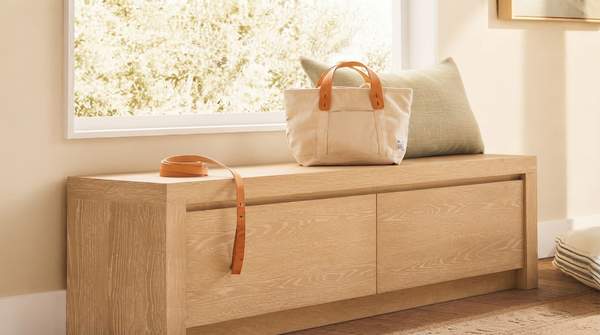
Storage Benches: Seating and Concealed Storage in One Piece
A bench might sound like a cumbersome addition to a tiny space, but Inspired Closets' designers argue the opposite: a small bench makes a limited entryway more practical, not less. It gives you a spot to sit while putting on shoes, and the space underneath can hold bins or cubbies for socks, hats, reusable shopping bags, and diaper bags—items that rarely have a good home anywhere else.
Installation is where benches shine for the tool-shy. A DIY bench guide from Truitt & White, a building-supply company, frames the bench as a project where you control every dimension so no inch of valuable space is wasted—though a custom build obviously demands real carpentry time. The faster route is a flat-pack bench: John Louis Home, a storage-furniture maker, says its bench assembles in about an hour using a cam-bolt system, with no handyman needed. Because the bench sits on the floor rather than hanging from a wall, there's no drilling, no stud finding, and no anchor risk.
Cost and time vary significantly with complexity and materials—a basic flat-pack or simple DIY option is affordable and fast, while a fully custom build is neither. Choose a bench if you want seating plus hidden storage and you'd rather not touch a drill.
Slim Profile Cabinets: Discreet, Closed-Door Organization
If your entryway's biggest problem is a pile of shoes next to the door, a slim shoe cabinet is the category built for that exact issue. Inspired Closets points out that the entryway usually functions as a catch-all space—especially for shoes—and that without a shoe organization system, that pile becomes both a tripping hazard and an eyesore that makes a small entryway feel even smaller. A well-laid-out shoe cabinet reduces the clutter and improves everyday convenience.
The category's defining feature is concealment. Unlike hooks or an open rack, a cabinet hides its contents behind doors, which keeps the visual line of your entryway clean. And because shoe cabinets are designed to be shallow—often just a few pairs deep—they occupy surprisingly little floor space relative to what they hold.
The trade-offs are weight and flexibility. A cabinet is a fixed piece of furniture: heavier to move than a coat rack, less adaptable than hooks, and typically the most expensive category on this list. It suits readers whose priority is a tidy, closed-off look and whose entryway has at least a narrow stretch of wall to spare. It's a poor fit for a space so tight that even a shallow cabinet blocks a door swing.
Standing Coat Racks: Flexible, Tool-Free, Corner-Friendly
The standing coat rack is the zero-commitment option. Wirecutter, the product-review site, highlights a standing rack with a heavy base that makes it more stable than other coat trees, and with nine hooks that each fold up when not in use—so it can hold a lot of coats and bags, or visually shrink to almost nothing on light days. That fold-away behavior is a genuine space-efficiency feature no wall hook can match.
Placement flexibility is the rack's other strength. Wirecutter's organizers make the case for corners: they're often overlooked, especially when a door swings open onto them, but smart storage picks can make the most of them both functionally and aesthetically. A freestanding rack is exactly the kind of piece that slots into a corner no bench or cabinet could use.
Installation is essentially nonexistent—no tools, no wall damage, which also makes it the best category for renters. The compromises are capacity and containment: coats hang in the open, there's no storage for shoes or small items, and a cheap, light-base rack can tip when loaded. Prioritize a stable base over hook count if you live somewhere windy or have kids who yank coats down.
Maximizing Storage in Very Small or Closet-Free Entryways
What if you have no entryway at all—just a door that opens into the living room? The professional organizers Wirecutter consulted for small entryways point to the same core strategy the wall-mounted categories use: go vertical and go into dead space. Corners are the clearest example. They're the spots most people write off, particularly when a door swings open onto them, yet they can host a standing coat rack or a narrow shelf that functions well and looks intentional rather than squeezed in.
Combine categories rather than choosing one. A common small-space formula: hooks or a floating shelf near the door for grab-and-go items, a slim shoe cabinet or bench against the nearest wall for the shoe pile, and a corner rack for overflow coats. Because hooks and shelves take zero floor space and a rack needs only a corner footprint, even a closet-free entry can gain a complete drop zone without blocking traffic flow.
One caution for tight spaces: measure your door swing before buying anything with depth. A bench or cabinet that intrudes even a few inches into the swing path will get bumped every single day, undoing the calm you were organizing for in the first place.
Choosing Your Ideal Entryway Storage Solution
Select an entryway storage solution category that aligns with your specific space constraints, DIY skill level, and aesthetic preferences. The short version: no tools and no wall damage means a standing coat rack; seating plus hidden storage without drilling means a storage bench; maximum storage with zero floor footprint means hooks and floating shelves; and a clean, concealed look for the shoe pile means a slim cabinet. Most small entryways are best served by pairing two categories—one vertical, one on the floor.
Your success measure is concrete: a functional and clutter-free entryway that efficiently stores coats, shoes, and bags. Walk out your front door tomorrow and note what's on the floor. If coats, shoes, and bags each have a designated home—and nothing is piled by the door—your chosen category is doing its job.
Sources
- Maximize a Small Entryway With These 5 Storage Solutions — Inspired Closets
- DIY Entryway Storage Bench: A Complete Guide • Truitt & White
- DIY Assembly Guide — John Louis Home
- How to Declutter a Small Entryway, According to Professional Organizers — Wirecutter: Reviews for the Real World