No insulation material is universally the best choice for your home. According to the Building Sciences Corporation, as cited by the Insulation Institute, all insulation types perform equally well when properly installed and air sealed — which means your real decision is about matching a material's R-value per inch, air-sealing behavior, and installation method to the specific space you're insulating. Spray foam delivers the highest R-value per inch (R-6.0 to R-6.5) and superior air sealing, while fiberglass, mineral wool, and cellulose offer comparable thermal performance around R-3.0 to R-4.3 per inch and depend on separate air-sealing measures to perform at their best.
Understanding R-Value and Insulation Types
R-value measures a material's resistance to heat flow: the higher the number, the better the material insulates. A guide from Leyton's insulation buyer resource explains that R-value helps maintain consistent indoor temperature, reduces energy bills, and prevents heat loss in winter and heat gain in summer. Because R-value is rated per inch of thickness, materials with a higher per-inch rating can achieve the same total thermal resistance in less depth — a real advantage in tight spaces.
Common residential insulation types, ordered by Focus on Energy from lowest to highest R-value per inch, include blanket insulation (batts and rolls), blown-in or loose fill, spray foam, and foam board. The actual R-value you get depends on the type, thickness, and density of the material, as well as temperature, moisture levels, and the age of the insulated space. If you're adding new insulation on top of an existing layer, all of those factors contribute to the overall R-value of the assembly.
One caution before you shop: a product claiming to be a "superior insulator" because of a higher R-value per inch isn't actually insulating better. The Insulation Institute notes that all products with the same total R-value insulate equally well, so the practical goal is to maximize the R-value you achieve for the dollars you spend in your chosen material.
Insulation Material Comparison at a Glance
The table below juxtaposes the thermal performance, air-sealing capability, and installation profile of the most common materials. Reading across the rows reveals the core trade-off: spray foam buys you high R-value in less depth plus built-in air sealing, while fiber-based materials cost less per inch of performance but require careful installation and separate air-sealing steps to reach their potential.
| Material | R-Value per Inch | Air Sealing | Installation Method | Key Benefit / Consideration |
|---|---|---|---|---|
| Fiberglass | R-3.0 to R-4.3 | Does not air seal on its own; needs standard air-sealing practices | Batts, rolls, or loose fill depending on the application | Cost-effective thermal and acoustic control; formaldehyde-free options available for indoor air quality |
| Mineral wool | R-3.0 to R-4.2 | Like fiberglass, relies on paired air-sealing measures | Batts | Superior fire resistance, sound absorption, and durability |
| Cellulose | R-3.2 to R-3.8 | Depends on density and moisture conditions | Blown-in / loose fill | Fills irregular cavities and attics effectively |
| Spray foam | R-6.0 to R-6.5 | Superior air sealing built into the product | Sprayed application | Highest R-value per inch; best where depth is limited |
| Foam board | Varies by material; polyiso boards are marketed for high R-value energy efficiency | Board product; joints require sealing | Rigid panels | Useful where a firm, continuous layer is needed |
Two qualifications matter when you use this table. First, the exact R-value of any material depends on the specific product and its density — these are typical ranges, not guarantees. Second, cellulose performance can be affected by density and moisture, so installation conditions matter more for it than for some alternatives.
Beyond R-Value: Air Sealing and Installation Quality
Choosing the best insulation isn't as simple as comparing R-value. Green Builder Media's buyer guide, written by editor-in-chief Matt Power, warns that an R-value chart "does not take into account any air leakage that can dramatically affect overall performance." In other words, a leaky attic insulated to a high nominal R-value can underperform a well-sealed one with more modest insulation.
The good news for budget-conscious homeowners is that fiber insulation doesn't need to leak. According to the NAHB Research Center and several independent tests cited by the Insulation Institute, when fiberglass and mineral wool insulation are paired with standard air-sealing practices — taped house wrap or caulk — air infiltration is effectively reduced to near zero. That means the air-sealing advantage of spray foam can be matched, at least in infiltration terms, by combining conventional insulation with diligent sealing work.
Installation quality is the other half of the equation. The Insulation Institute's central point — that all insulation types perform equally well when properly installed and air sealed — cuts both ways: even the highest-R-value material will disappoint if it's compressed, gapped, or installed without addressing air leakage. Settling is another factor worth considering over time, particularly for loose-fill products.
Matching Insulation to Different Areas of Your Home
Different insulation works best in different places. Focus on Energy puts it plainly: the insulation you install in your attic might not be the best choice for your basement, and vice versa. Before picking a product, consider the conditions of the space itself.
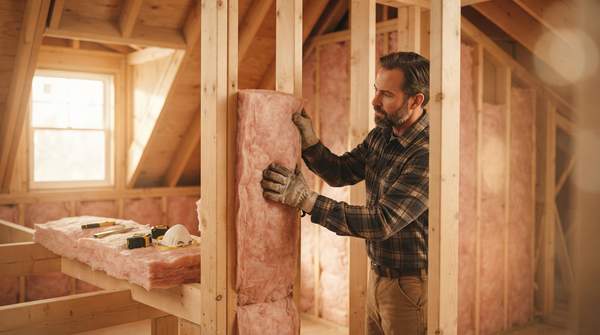
For attics, loose-fill materials such as blown cellulose are a natural fit because they fill irregular, hard-to-reach spaces effectively, and depth is usually less constrained than elsewhere in the house. Fiberglass is available as batts, rolls, or loose fill, so it can flex to the application: batts and rolls suit standard wall cavities, while loose-fill suits attics and irregular spaces.
For walls and finished spaces, batt products — fiberglass or mineral wool — fit standard stud cavities, and mineral wool's fire resistance and sound absorption make it attractive where safety and noise control are priorities. For basements and tight or shallow cavities, a higher R-value per inch becomes more valuable, which is where spray foam's R-6.0 to R-6.5 rating and its built-in air sealing earn their premium. Foam board offers a firm, continuous layer where a rigid product is needed.
Geographic location also shapes the decision. The Leyton guide notes that colder regions call for higher total R-values, while warmer areas may get by with moderate insulation. Focus on Energy similarly directs homeowners to identify their zone and its recommended R-value before choosing a product — though determining your specific climate zone's requirements is a step this comparison doesn't cover in full.
Choosing the Right Insulation for Lasting Comfort and Efficiency
Homeowners should select insulation by balancing R-value per inch with air-sealing capabilities, installation method, and the specific benefits relevant to the application area. In practice, that means asking three questions in order: How much total R-value does my space need, and how much depth do I have to achieve it? Does the material air seal on its own, or will I add sealing measures? And can I install it properly myself, or does it require a professional crew?
If depth is plentiful and budget matters most, fiberglass or cellulose paired with careful air sealing delivers strong performance per dollar. If the cavity is shallow, the space is moisture-prone, or you want air sealing built in, spray foam's higher per-inch rating justifies itself. If fire resistance or sound control is the priority, mineral wool stands out. And no single material is universally superior — the balance among these factors is what determines your home's overall energy efficiency and comfort.
Two boundaries to keep in mind: this comparison doesn't provide project-specific cost estimates, and it doesn't address local building codes, so confirm requirements with your local authority before installation. The measurable indicator of success is straightforward: improved indoor temperature stability and reduced energy bills after your insulation upgrade. Track your heating and cooling costs before and after the work, and you'll have concrete evidence of whether your material choice and installation quality delivered the performance you planned for.
Sources
- Insulation Types — Insulation Institute
- Ultimate Insulation Buyer Guide 2026 : Best Options and R-Value Chart — Leyton
- Understanding R-Values and Insulation — Focus on Energy
- Insulation R-Values Chart and Buyer Guide — Greenbuildermedia