A tile sample covers a patch of wall about the size of your hand. In the bathroom, that same colour or pattern might run behind the basin, climb to the ceiling and meet itself in the mirror. Decide how far you’d like it to travel before you decide whether you can live with it.
Fully tiled bathroom walls carry the finish from floor to ceiling. Half-tiled walls leave space for paint above the tiles, and the tile height can vary between areas. The decision comes down to where you want a continuous finish, where you’d enjoy seeing colour change and which walls are regularly exposed to water.
Work Out Where the Tiling Needs to Reach
Begin with the areas that get wet most often. A bath used for soaking has a different pattern of splashes from one with an overhead shower. Water around the basin tends to land closer to the fitting, so the wall above it can have a different finish or tile height from the bath or shower area.
The wall by the door may stay dry while the opposite wall gets regular spray. That can leave room for a lower band of tile in the drier part of the bathroom. In areas exposed to frequent wetting, the surface behind the tile also needs to be suitable for that exposure. Settle what the wet area needs before you carry a decorative line across the rest of the room.
With RenDec’s wall tiling and bathroom supply and fitting services, you can discuss those choices together for a Swanage refit. Tile height is worth bringing into the conversation while you’re still deciding where the basin and mirror will sit. A comfortable mirror position can also give you a natural place to end a band of tile.
When a Fully Tiled Bathroom Looks Right
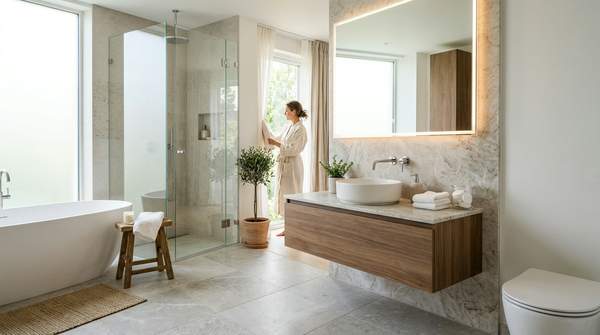
Imagine a compact bathroom where the basin, bath and window all sit on the same wall. A continuous tile can give those features a quieter backdrop. The mirror and fittings can hold the eye without a horizontal band passing behind each one at a different point.
A muted tile with little variation from piece to piece can look calm across a larger surface. If you’re drawn to a strong geometric design, picture several rows of it and look at what the mirror will reflect. From the doorway, you may see the pattern in the mirror as well as on the wall.
Look closely at the places where a pattern has to turn or stop. A window recess or a boxed-out section can interrupt a design that looks regular across a flat wall. If the effect relies on a continuous motif, a plain companion tile inside the recess can let the design carry across the main wall without an awkward turn.
Give Half-Tiled Walls a Deliberate Top Edge
The top edge of a half-tiled wall becomes a line you’ll see from the doorway. Mark two possible heights with masking tape, one aligned with the sill and the other near the basin. A few centimetres can be the difference between a clean line under a mirror and a narrow strip of painted wall that looks accidental.
Consider tile size once you’ve found a height you like. If it leaves room for only a thin cut along the top, see whether a small change in height would give you a fuller final row. A window sill may give you a firm stopping point, while a blank wall gives you more room to adjust the line.
A painted upper wall gives you another colour to work with. A deep blue above a pale tile can make a small area behind the basin feel more distinct. A paint colour close to the tile can soften the transition, leaving the difference in texture to do the work. A lower band can give you room to use the patterned tile you love and still leave a quieter surface above it.
Sometimes the best place for a change in tile height is an inside corner, where one wall already ends and the next begins. A stop halfway along an open wall is much more visible. It can work beside a window or a change in depth, where there’s already a natural break in the surface.
Look at the Floor Before You Settle the Walls
If the bathroom floor will be tiled too, put the wall samples next to the floor sample. A strong pattern underfoot can work with a plain wall even in a fully tiled room. A quiet floor can leave room for a stronger wall finish around the basin. Looking at the two surfaces at the same time gives you a better sense of which one will draw your eye as you walk in.
The floor can also make a half-tiled scheme feel more connected. A colour that appears in both the floor and the wall tiles can carry across the room even if the wall tiles change height. If you’d prefer to draw attention to a single wall, keep the floor and the surrounding surfaces quieter so that the change feels intentional.
See the Finish at Room Scale
Take a photo from the doorway and draw in your preferred tile line. If you’re still drawn to the patterned tile, try filling just the basin wall with it and carrying a simpler finish around the rest of the room. You may find that gives you exactly as much of the pattern as you’d enjoy waking up to.
Bring that view to RenDec when you enquire about bathroom tiling. Take the tile and paint colours you’d like to see together into the enquiry, whether your plan is a full-height wall behind the mirror or a line of colour just above the basin.