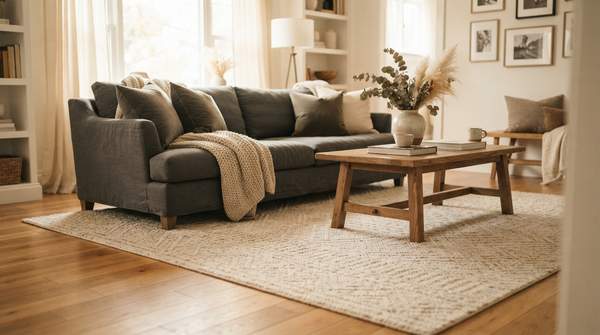
The fastest way to choose a coffee table for a small living room is to stop browsing shapes and start with your biggest frustration. If you work or eat in your living room, a lift-top table is the category to explore. If you entertain and need surfaces that appear and disappear, nesting tables fit. If clutter is the enemy, hidden storage in an ottoman or trunk does the job. And if your room is truly tiny, skipping the central table entirely and distributing smaller surfaces may beat any of them. Here is how to match the problem to the solution, and the measurements to check before you buy.
Decision Framework: Matching Your Need to the Right Coffee Table Type
Design guides from furniture retailers consistently sort space-saving coffee tables by what they do rather than how they look. Decor Furniture's buying guide highlights nesting sets for flexibility, round tables for visual lightness, narrow tables for tight widths, and lift-top tables that double as work or dining surfaces. SICOTAS, writing about coffee table alternatives, adds the C-shaped table that slides under a sofa, and VBU Furniture's 2026 comparison guide frames the nesting-versus-single choice around how often you entertain and whether you need hidden storage.
Start by naming your primary need, because that single answer eliminates most of the field. A table that solves your number-one problem is worth more than one that merely looks right in the room.
Small Space Coffee Table Decision Framework
Use this table to move from your main living room challenge to the one or two table types worth researching further, along with the trade-off each one carries into your space.
| Primary Need | Best-Fit Table Type | Key Considerations for Small Spaces | Trade-offs / Measurements |
|---|---|---|---|
| Part-time workspace or dining surface | Lift-top coffee table | The top rises and extends forward to create a raised surface, ideal when a dedicated workspace or dining area is not feasible | Mechanism strength and lift limits vary by model; review manufacturer details carefully |
| Flexible surfaces for guests and changing layouts | Nesting tables | Smaller tables fit under a larger one, expanding for guests and tucking away when the room needs open space; useful for studio apartments and small condos | Best for dynamic, multipurpose rooms; a single table suits stable layouts better |
| Hiding clutter, plus extra seating or a footrest | Storage ottoman or trunk | Combines hidden storage with other functions like seating or a footrest | Test tray stability before use; trays with raised lips or non-slip bases hold better on fabric |
| Preserving floor space in the smallest rooms | C-table or slim tray table | The base slides under the sofa so the top hovers over your lap or beside the armrest, using almost no floor space | Measure the clearance under your sofa first; many modern frames sit too low for the base to slide underneath |
| Maximum usable surface along a tight wall | Narrow, long table | Placed along the length of a sofa, it maximizes surface area without crowding the room | Measure your sofa length first to keep proportions balanced |
Two quick tie-breakers can help if you land between rows. Round tables avoid sharp corners, which Decor Furniture's guide notes makes them safer and visually lighter in a tight space. And VBU Furniture's guide offers a thirty-second heuristic: small or multipurpose living room, choose nesting; stable seating layout or hidden storage, choose a single table; frequent entertaining, choose nesting again.
Key Trade-offs and Critical Measurements for Smart Buying
Once you have a category, three measurements and one physical test separate a smart purchase from a regrettable one.
Clearance from seating. Decor Furniture's guide recommends maintaining at least 18 inches of clearance between the coffee table and seating to promote a spacious feel without crowding. Treat this as a general design guideline for spaciousness rather than a strict rule for every layout, but measure your sofa-to-table gap before committing to any footprint.
Sofa clearance for C-tables. The C-table only works if its base slides under your sofa. SICOTAS is blunt about the failure mode: many modern sofa frames sit too low for the base to slide underneath, and that kills the whole idea. Measure the gap under your sofa arm before buying, not after.
Mechanism quality for lift-tops. Decor Furniture cautions that mechanism strength and lift limits vary by model, so manufacturer details deserve a careful read. For a sense of what the hardware can handle, one lift-top mechanism listing on Amazon specifies a gas hydraulic hinge in 2.5mm and 4mm thicknesses with a stated maximum weight capacity in the 100-200 pound range. Mechanism thickness and capacity vary between products, so check the specific specs of the table you are considering rather than assuming all lift hardware performs the same.
Tray stability on ottomans. If you choose a storage ottoman or trunk, SICOTAS suggests a simple stability test: place the tray on the empty ottoman and press one corner firmly. If it tilts, it will likely tilt with a full mug. Trays with a raised lip or a non-slip base are noted to offer better stability on fabric surfaces. This matters because soft tops behave differently from hard tables, which wipe clean, hold weight anywhere on the surface, and never need a tray.
One more honest counterpoint from SICOTAS is worth weighing: depth is usually the problem in a small room, not length. A space-saving rectangular table keeps the flat surface you actually wanted while returning most of the walkway you lost, so try going narrow before writing off tables entirely.
The 'No Coffee Table' Strategy: When and How to Implement It
For the smallest rooms, the best coffee table may be no coffee table at all. SICOTAS names the C-table, a single side table, a single pouf, or nesting tables as the right moves for the smallest spaces, where the priority is reclaiming the central floor rather than decorating it. This approach suits rooms that must serve multiple masters: a play area that needs open floor, a workout space that appears in the morning, or a high-traffic path where a central obstacle gets bumped constantly.
Implementing it well means distributing surfaces so no seat is stranded. A C-table slides under the sofa for a laptop and a mug. A side table anchors one end of the seating. A pouf offers a soft landing spot that can double as a footrest. Nesting tables give you the expand-and-tuck flexibility of a full table set without a permanent central footprint. The goal is that every seat has somewhere to set a drink within reach, even though the middle of the room stays clear.
Be honest about what you give up, though. Hard surfaces wipe clean, hold weight anywhere on the top, and never need a tray, as SICOTAS notes. If you regularly carry full mugs, plates, or laptops across the room, the distributed approach adds friction. It works best when your main use of the living room is movement and flexibility rather than settled, surface-heavy lounging.
Reclaim Your Space: Making the Right Coffee Table Choice
Choose a coffee table type that directly addresses your primary functional need in a small living room, or opt for a "no coffee table" strategy with distributed surfaces if central floor space is paramount. The framework above narrows the field to one or two candidates, and the measurements section tells you exactly what to verify before money changes hands: the 18-inch seating clearance, the under-sofa gap for a C-table, the mechanism specs for a lift-top, and the corner-press tray test for an ottoman.
You will know you chose well by a simple, observable outcome: the living room feels more spacious and organized, with surfaces readily available for essential functions without cluttering the central area. If drinks still have nowhere to land from the sofa, or the walkway feels pinched, that is your signal to move one row up or down the framework and try the next best-fit type.
Sources
- Best Coffee Tables for Small Living Rooms: Space-Saving Guide — Decor Furniture
- 10 Coffee Table Alternatives That Work Better in Small Living Rooms — SICOTAS
- Nesting Coffee Tables vs Single Coffee Table (2026 Guide) — VBU Furniture | Value. Beauty. Utility.
- Amazon.com: BAZAC 2 Pcs Lift Up Top Coffee Table Mechanism Hardware Hinges,…