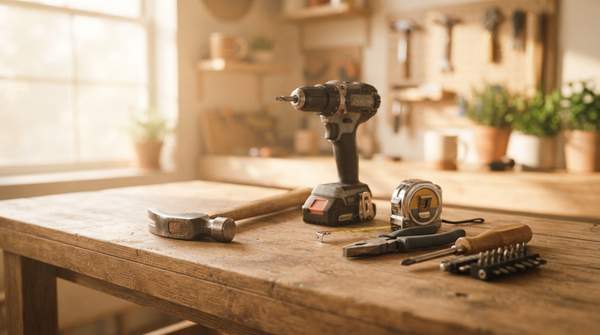
You don't need a garage full of equipment to handle most homeowner tasks. Across home improvement guides, the same short list keeps appearing: a cordless drill/driver, a tape measure, a utility knife, a level, and a set of pliers. Buy those five first and you can assemble furniture, hang pictures and shelves, make accurate cuts, and grip or bend fasteners and wire. This guide compares each tool's primary job, its secondary uses, and the trade-off a beginner should weigh before spending money.
Why a Starter Toolkit is Essential for New Homeowners
Owning a home brings a steady stream of maintenance and repair responsibilities, and having the right tools on hand makes those jobs far more manageable. That's the starting point This Old House's experts—Tom Silva, Richard Trethewey, and Jenn Nawada—use when recommending tools for first-time DIYers: identify the essentials before you buy anything.
Their advice begins with an honest self-assessment. Before purchasing tools, they recommend considering your skill level and the project types you're likely to tackle. Common homeowner tasks they list include assembling furniture, basic plumbing repairs, hanging pictures and shelves, minor electrical work, and yard maintenance. By anticipating your needs, you can prioritize which tools to acquire first.
That framing matters because it changes the shopping question. Instead of asking "what does a complete workshop contain?"—one widely shared list from Wagner Meters runs to 50 tools—you ask "what will I actually use in the first year?" A builder's perspective backs the same conclusion: DSLD Homes, a homebuilder, notes that owning essential maintenance tools lets you tackle the most common household repairs with ease, saving time, money, and headaches over the long run.
There's also a practical limit to what a beginner should attempt. This guide covers common, basic home maintenance and light DIY. It is not a manual for advanced woodworking, plumbing, or electrical work—and none of the tools below will make those projects safe to improvise.
Foundational Tools for Your First Home
Here are the five tools that earn their place in a starter kit, based on the consensus of the guides above.
1. Cordless drill/driver. This Old House calls the drill/driver "perhaps the most versatile and essential power tool for any homeowner," because a good one both drills holes and drives screws, making it indispensable across a wide range of projects. A repair guide from Almighty Tools agrees, describing the cordless drill as invaluable for drilling holes and driving screws quickly and efficiently. It's the single tool that speeds up the largest number of everyday tasks, from furniture assembly to hanging shelves.
2. Tape measure. Wagner Meters calls the tape measure "the cornerstone of every toolbox," because a reliable one keeps your projects accurate and precise. Almost nothing else on the list works well without it—cutting, drilling, and hanging all depend on measuring first.
3. Utility knife. The same guide highlights how many uses a utility knife has: cutting through various materials, opening packages, and trimming edges. It recommends choosing one with a retractable blade for safety and easy storage.
4. Level. A level ensures your projects are perfectly horizontal or vertical. Wagner Meters suggests a 24-inch model with both bubble and digital readings for maximum utility.
5. Plier set. Needle-nose, slip-joint, and tongue-and-groove pliers cover gripping, cutting, and bending wires, nails, and other materials, according to Wagner Meters. Together they handle the fastening and adjusting jobs a screwdriver can't.
One purchasing note on the drill: This Old House points out that most major manufacturers—DeWalt, Ryobi, and Milwaukee—sell combo sets built around a drill/driver, often bundled with tools like a circular saw, jigsaw, or orbital sander. Even if you're not ready for a combo set, they recommend starting with a drill/driver whose battery can be shared with those other tools later. That's a deliberate hook for future expansion, not a reason to overspend on day one.
Essential Homeowner Tools: A Versatility Comparison
The table below synthesizes the recommendations above into a decision-focused comparison. Each row shows what the tool is primarily for, what else it covers, and the trade-off to weigh as a beginner. Read it to decide what to buy first: the tools with the widest "versatile for" column deliver the most value per dollar in a starter kit.
| Tool | Primary Function | Versatile For | Beginner's Trade-off |
|---|---|---|---|
| Cordless drill/driver | Drills holes and drives screws quickly and efficiently | Furniture assembly, hanging pictures and shelves, a wide range of repair projects | Higher initial cost than hand tools, but saves significant time and effort; a basic model with a shareable battery is enough to start |
| Tape measure | Ensures projects are accurate and precise | Measuring for cuts, drilling, hanging, and layout—supports nearly every other tool on this list | Very low cost, but only useful if you actually measure before cutting or drilling |
| Utility knife | Cuts through various materials | Opening packages, trimming edges, general cutting tasks | Inexpensive; choose a retractable blade for safety and storage |
| Level | Confirms surfaces are perfectly horizontal or vertical | Hanging pictures and shelves straight; checking installed items | A 24-inch model with bubble and digital readings offers maximum utility, at a higher price than a basic bubble level |
| Plier set (needle-nose, slip-joint, tongue-and-groove) | Gripping, cutting, and bending wires, nails, and other materials | Fastening and adjusting jobs, basic plumbing-adjacent gripping tasks | Buying all three types costs more than one pair, but each covers different gripping and bending jobs |
The pattern in the table is the takeaway: the drill/driver carries the highest price but the widest workload, while the four hand tools are individually cheap and each covers a distinct category—measuring, cutting, checking, and gripping. That's why the drill is the priority purchase and the hand tools are the quick wins around it.
Consistent with the boundaries of this guide, the table deliberately omits specialty gear. It doesn't include specific model recommendations or exact, real-time prices—those change constantly—but the trade-off column captures the value decisions that matter: pay more for versatility and speed where it counts, and stay basic elsewhere.
Building Your Toolkit Smartly: A Phased Approach
New homeowners should prioritize acquiring a core set of versatile tools first, then gradually expand their collection based on specific project needs and budget, rather than attempting to buy a comprehensive set upfront. That phased strategy is exactly what This Old House's guidance supports: anticipate the projects you're likely to tackle, prioritize which tools to acquire first, and—if you start with a drill—choose one whose battery platform can power future tools when a real project demands them.
The approach relieves the pressure to buy everything at once. A 50-tool list is a destination, not a shopping trip. Your first five tools handle the most common tasks; everything after that should be purchased when a specific job calls for it.
The measurable indicator that your starter kit is working: the homeowner successfully completes basic maintenance tasks using their initial toolkit and identifies specific project needs that warrant additional tool purchases. When you hit a job your five tools can't cover—say, a straight rip cut that needs a circular saw—that's your signal for the next purchase, not before.
Sources
- Tool Recommendations for New Homeowners — This Old House
- 50 Must-Have Tools for the DIY Homeowner — Wagner Meters
- Top Home Maintenance Tools Every Homeowner Should Own — Dsldhomes
- Essential Home Repair Tools for Homeowners — The Almighty Tools