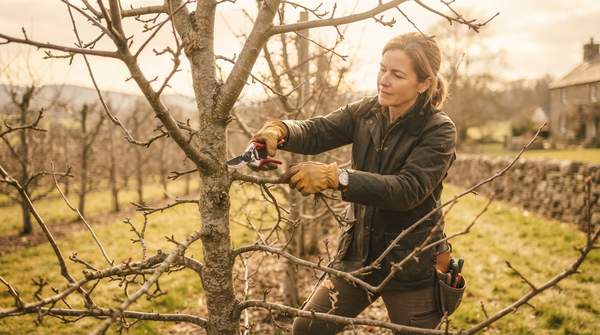
The single most important decision in fruit tree pruning is not which branch to cut — it is when to cut it. Prune most fruit trees while dormant, in late winter, and you stimulate vigorous growth and build the tree's structure. Prune in summer and you slow the tree down, keep it compact, and direct its energy into ripening fruit. Timing matters so much that, as one Pacific Northwest nursery guide puts it, pruning at the wrong time of year can invite disease, reduce next year's crop, or weaken the tree, while pruning at the right time means even imperfect cuts produce strong growth and reliable fruit.
Understanding Fruit Tree Pruning: Why Timing Matters
The reason timing drives everything is the tree's seasonal energy cycle. Orchard educator guidance from Orchard People explains that winter pruning encourages vigorous growth, while summer pruning slows things down. Prune in late winter and you are telling the tree to grow; prune later in the season and you are asking it to take things slow. Winter pruning is especially good for young trees because it spurs vigorous growth, while summer pruning is best if you want to keep your fruit trees small.
This means the same cut made in February and made in July produces opposite results. A dormant cut removes buds the tree would have opened, and the stored energy behind it pushes strong new shoots in spring. A summer cut removes leaves — the tree's energy factory — after the season's growth push, so the tree has less fuel for further expansion and puts more of its remaining resources into fruit development.
There is also a disease dimension. Stone fruits such as peaches and cherries are more susceptible to infection when pruned in cold, wet conditions, so their schedule differs from apples and pears. And there is one window to avoid entirely: fall and early winter, roughly October through December, when the tree has no time to heal before cold arrives, according to The Giving Grove's dormant pruning guidance.
Year-Round Fruit Tree Pruning Calendar
The calendar below classifies each season's pruning tasks by tree type, separating pome fruits (apples, pears) from stone fruits (peaches, cherries) because their disease risks and growth habits demand different schedules. It is built for home gardeners; adjust exact dates to your local climate and variety.
| Season | Pruning Goal | Pome Fruit (Apples, Pears) | Stone Fruit (Peaches, Cherries) |
|---|---|---|---|
| Dormant season (late January–early March) | Stimulate vigorous growth; establish structure; remove dead or diseased wood | Prune for structure and airflow; remove dead, diseased or crossing branches; shape toward a central leader or modified central leader | Prune for structure and remove dead or diseased wood, but delay major peach cuts until end of February or after risk of hard freezes passes; avoid pruning during precipitation to prevent disease spread |
| Spring (March–May) | General maintenance; protect new growth | Expand mulch rings; monitor for insect and disease issues; no major pruning | Finish any delayed peach pruning once hard-freeze risk has passed |
| Summer (June–August) | Control tree size; improve light penetration to fruit; encourage fruiting spurs for next year | Light touch-up cuts only for size control | Perform major pruning for peaches to manage size and shape; summer cutting reduces disease risk compared with dormant pruning for stone fruit |
| Fall (September–December) | None — healing window closed | Do not prune | Do not prune |
Two rules anchor the whole schedule. First, dormant pruning should happen before trees begin to bud, so the tree heals as it wakes up and grows in spring. Second, never prune during precipitation, because wet cuts invite the spread of disease and rot.
Dormant Pruning: Shaping for Vigor and Structure
Dormant pruning is your annual opportunity to build the tree. The goal is a strong framework: remove dead, diseased or crossing branches, open the tree for airflow, and shape it toward the structure that suits its type. Apples and pears are typically trained to a central leader — a single main trunk with scaffold branches radiating outward — or a modified central leader. Peaches and other stone fruits are often trained to an open-center (vase) shape instead, which lets light reach the interior fruit. Not all trees share the same ideal structure, so follow the pattern appropriate to your tree.
Two basic cuts do the work. A thinning cut removes a branch back to its point of origin or to a larger limb, opening the canopy without stimulating a flush of regrowth — ideal for airflow and light. A heading cut shortens a branch, which concentrates the tree's energy into the buds just below the cut and produces vigorous, branching regrowth — useful for building scaffolds on young trees, but a source of clutter if overused.
For stone fruits, the dormant window needs care. The Giving Grove's maintenance calendar recommends pruning peaches at the end of February, or after the risk of hard freezes has passed, precisely because cutting them earlier in cold, wet weather leaves them exposed to disease. Apples and pears tolerate the full late-winter window.
Summer Pruning: Managing Size and Enhancing Fruit Quality
Summer pruning is the counterweight. Where dormant cuts say "grow," summer cuts say "slow down." By removing leafy growth after the main spring push, you reduce the tree's energy supply, which keeps its size in check — the approach Orchard People recommends for gardeners who want small, manageable trees. Better light penetration through a thinned canopy also helps fruit ripen and color, and supports the formation of fruiting spurs for the following year.
For peaches, summer is when major size-and-shape pruning can happen with lower disease risk than in the dormant season. For apples and pears, keep summer work light: a touch-up for size control rather than a restructuring session. Heavy summer pruning of pome fruit removes too much foliage and can cost you next year's crop.
Remember the boundaries of this schedule. It covers fruit-bearing trees only, not ornamentals, and it addresses pruning for prevention rather than pest or disease treatment. Commercial orchard management follows its own, more intensive programs.
Making the Cut: Your Pruning Action Plan
Home gardeners should adopt a year-round pruning strategy, prioritizing dormant pruning for structural development and vigor, and summer pruning for size control and fruit quality, adjusting for specific fruit tree types and local climate. In practice: mark late January through early March on your calendar for structural work on apples and pears, hold peach pruning until the end of February or after hard freezes pass, keep summer cuts light on pome fruit and more substantial on peaches, and leave the shears in the shed from October through December.
The measurable indicator of success is observable in your own trees: improved tree health, balanced growth, increased fruit size, and consistent fruit production over successive seasons. If your tree is growing too vigorously, shift more of your pruning into summer; if it is weak or slow, favor dormant cuts. Watch how your tree responds each year and let that response refine the calendar for your climate and variety.